
Rush County Traffic Warrants Explained
A traffic ticket written in Rush County is a court case from the start. Pay it, contest it, request a deferral, or appear as directed. Miss a required step, though, and the docket can grow a failure-to-appear entry, a warrant, a suspension entry, or another enforcement order. Indiana sources use terms such as arrest warrant, bench warrant, and warrant for failure to appear. The phrase “capias pro fine” is not the local term in the official Indiana material. Rush County also has no separate municipal, city, or justice-of-the-peace traffic court in the current Indiana court directory. Traffic and infraction matters go to Rush Circuit Court or Rush Superior Court. The court that owns the case controls any warrant, bond, reset, or recall. Police issue the citation, and the Sheriff may serve a court warrant. Neither role turns it into a city payment case.
Rush County Assigns Infractions by Month
Rush Local Rule LR70-AR 00-1 gives a routing clue for Rush County infractions. An infraction opened in an odd-numbered month goes to Rush Superior Court. One opened in an even-numbered month goes to Rush Circuit Court. The filing month controls, not the ticket date. Processing delays can push a filing into a later month than the stop. MyCase is still the better way to identify the actual Rush County court.
70C01 is the Rush County Circuit Court identifier shown in Odyssey. 70D01 is Rush County Superior Court, the other Odyssey court. FTA means failure to appear, a missed required court setting.
Both courts sit on the third floor of the Rush County Courthouse at 101 East 2nd Street in Rushville. Circuit Court can be reached at 765-932-2078, Superior Court at 765-932-3520.
Checking for a Traffic Warrant
Start at Indiana MyCase, the public case-information system for Odyssey courts. It is not a statewide active-warrant roster. It is not the certified court record either. A careful Rush County traffic warrant search uses the strongest identifier available, then follows through with the local record keeper.
- Enter the exact citation number in the Case search route. If needed, try the case or cross-reference number.
- When no number is available, use the Name tab with last and first name, middle name, and date of birth when known.
- Limit the Court control to Rush Circuit Court, Rush Superior Court, or both, and review Open as well as relevant Closed cases.
- Read the chronological case summary for warrant, failure to appear, recall, quash, bond, payment, or hearing entries.
- Call the Rush County Clerk at 765-932-2086 with the case or citation number, then contact the issuing court for current instructions.
- For service, custody, or planned-surrender questions, call the Rush County Sheriff at 765-932-2931 before appearing.
The Rush County Clerk maintains records for both courts and offers a public terminal and records room. Staff do not run broad criminal or civil searches. Arrive with a specific case and document request.
MyCase Fields for Rush Traffic Warrants
The portal offers several ways to narrow a Rush County traffic case. A citation number has no single statewide format. It often must match the Odyssey entry. Hyphens and leading zeros may drop from an Indiana case number. A name search takes a trailing asterisk as a starts-with wildcard, and Sounds-like catches spelling variants.
| Control | Best Use | Local Note |
|---|---|---|
| Citation number | Exact ticket search | Enter the stored value as closely as possible. |
| Case number | Known court case | Hyphens and leading zeros may be omitted. |
| Name and birth date | No ticket number | Add detail to reduce common-name matches. |
| Court | County filter | Select 70C01, 70D01, or both. |
| Status and dates | Limit results | Closed cases can still show past warrant events. |
| Make a Payment | Eligible case only | Its presence does not prove warrant recall. |
MyCase caps results at 1,000. It may also show a captcha. Citations fresh off the printer can lag, so if a ticket is too new to appear, follow the timing printed on it or ask the Rush County Clerk when the filing is expected.
Inside a Traffic Warrant Record
Read a public docket in order. First, match the party and citation to the right case. Then find the court and work through the later entries to see whether the judge issued, served, recalled, or quashed a warrant. The balance field is separate. It can lag a payment or a new charge. Only the court maintaining the Rush County case can confirm the record officially.
| Warrant or citation number | The ticket identifier or court cause number, shown here only as a format-neutral sample: CITATION NUMBER. |
|---|---|
| Party and case | Name and public case caption used to distinguish similar results. |
| Charge or infraction | The alleged traffic or infraction count filed with the court. |
| Issuing court | Rush Circuit Court or Rush Superior Court, which controls the order. |
| Chronological events | Hearings, failure to appear, warrant issuance, bond, recall, or later disposition. |
| Financial information | Public balance that must be checked with the Clerk before payment. |
A closed caption likewise tells you nothing about the warrant on its own. Read the full chronology and call the Rush County court.
Rush County ePay Is Conditional
The official Indiana court payment service can offer a “Make a Payment” path for an eligible case. That screen is a payment and case service, not a Rush County warrant list. An unpaid case may not qualify online. An accepted payment may still leave a judge's separate appearance, bond, or motion requirement unsatisfied.
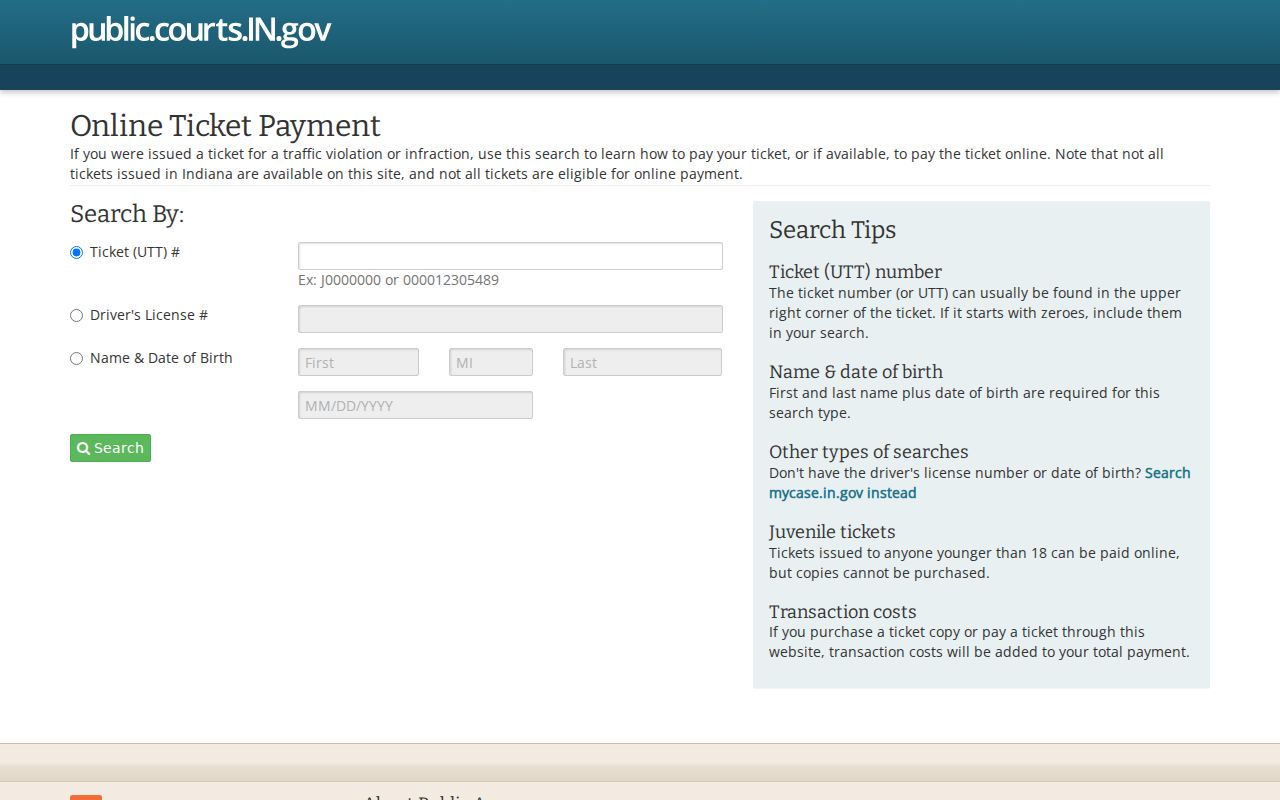
The state payment screen is a warning. It shows why the docket and the court's instructions must be read together. Get the balance from the Clerk. Before any money moves, ask the Rush County issuing court what act changes the warrant status.
How to Pay or Lift a Traffic Warrant
Rush County publishes no warrant-recall form, fixed bond schedule, special walk-in calendar, or guaranteed online cure. Resolution starts with the exact docket. Ask the issuing court the direct question. A lawyer can lay out the choices and file a motion when one is needed.
- Save the UTT or citation number, issuing agency, court date, and all instructions printed on the ticket.
- Find the case in MyCase and note the court identifier, cause number, latest events, and payment eligibility.
- Call the Clerk for current financial information and the issuing court for the required step, which may involve payment, a reset, an appearance, bond, or a motion.
- Call the Sheriff before a planned surrender because no Rush County after-hours or bond-window procedure was published.
- After acting, confirm that the docket contains the expected recall, quash, appearance, payment, or compliance entry.
Caution: A successful online payment does not itself prove that a Rush County traffic warrant has been recalled by the issuing judge.
Never trust a third-party payment demand. Hang up on unofficial callers too. Verify the court phone through an official Rush County or state court source, and keep receipts, confirmation numbers, and filed documents.
Rush County Infraction Deferral
A Rush County ticket can snowball into a warrant. The Prosecutor's infraction deferral program offers a different exit. It lets an eligible driver settle up early. The program addresses a ticket before it becomes an unresolved court problem. This is not amnesty, and it will not clear an active warrant in Rush County. Eligibility requires a Rush County ticket, no infractions for six months, and a signed agreement. The total cost is $192.50. The program period is twelve months, with dismissal after successful completion and reactivation after a new infraction. The Rush County Prosecutor page lists exclusions and intake details. Callers leave a name, phone number, issuing officer, offense, and UTT number, and the office states a 72-hour response period.
Deferral sits with the prosecutor's traffic work. Once MyCase shows an FTA or warrant, call the Rush County issuing court before assuming deferral still applies.
Traffic Warrants, FTA, and License Holds
One missed ticket raises several questions. The labels, though, mean different things. A Rush County traffic warrant is court process that may authorize arrest. An FTA is the missed court date itself. A license hold is a separate status run through state process. Rush County publishes no local license-hold program or per-charge compliance fee.
| Mechanism | Source | Correct Confirmation |
|---|---|---|
| Traffic warrant | Order in the court case | Issuing Rush court and docket |
| Failure to appear | Missed required setting | Chronological case summary and court |
| Financial balance | Costs, fine, or other assessment | Rush County Clerk |
| License or compliance status | Separate state process | Ask the court first, then BMV if directed |
Indiana's driving-record service answers a different question. It sits outside the Rush County court-record process, and clearing one record does not change every other status.
Missed a Rush County Traffic Date
A missed Rush County court date needs action, not guesswork. Search the case by citation number first. New chronological entries show what the court did after the missed appearance. Call the Clerk with that number. Ask which court owns the case. Then call the court administrator. Ask whether the judge requires a reset request, a personal appearance, bond, payment, or a filed motion. Circuit Court and Superior Court share the same courthouse but may follow different case-specific orders. If the docket shows an active warrant, speak with counsel when possible. Then call the Sheriff. Ask for current surrender and custody instructions. Rush County runs no safe-surrender event. There is no grace period or warrant walk-in window either. Do not assume there is time to wait just because the online docket has not changed yet. Odyssey is Indiana's reminder program. It lists Rush as a participating county and sends criminal-case reminders when a cellphone number is stored; reminders help prevent later missed dates, but they do not replace the notice in a court order and do not cancel an existing FTA.