
Rush County Bench Warrants Explained
A bench warrant brings a person before a judge. Several missteps can trigger it. In Rush County, one can follow a missed criminal hearing, a failure to appear after a summons, a breach of a release term, or a required civil or family appearance. The docket holds the real reason. A missed date alone settles nothing in Rush County. That detail is easy to overlook. The judge may have entered a warrant, a body attachment, a new date, or another order entirely. Rush County runs two trial courts of record. Rush Circuit Court and Rush Superior Court each handle assigned criminal, infraction, family, juvenile, and civil matters. No Rushville, Carthage, or Glenwood municipal court appears in the current state listings. So in Rush County the case number and the issuing court matter more than the city where a stop or citation began.
Rush Bench Warrant Docket Trail
The local process can be read as a line: scheduled hearing → nonappearance or alleged noncompliance → judicial order → Clerk docket entry → service or recall. MyCase may show the hearing and a later event, but it is not the official record and may omit documents. The Clerk keeps the file. Only the issuing judge can change the warrant.
Rush County takes part in Indiana's Odyssey hearing-reminder program. The state's page describes a text tool built to cut down on missed hearings.
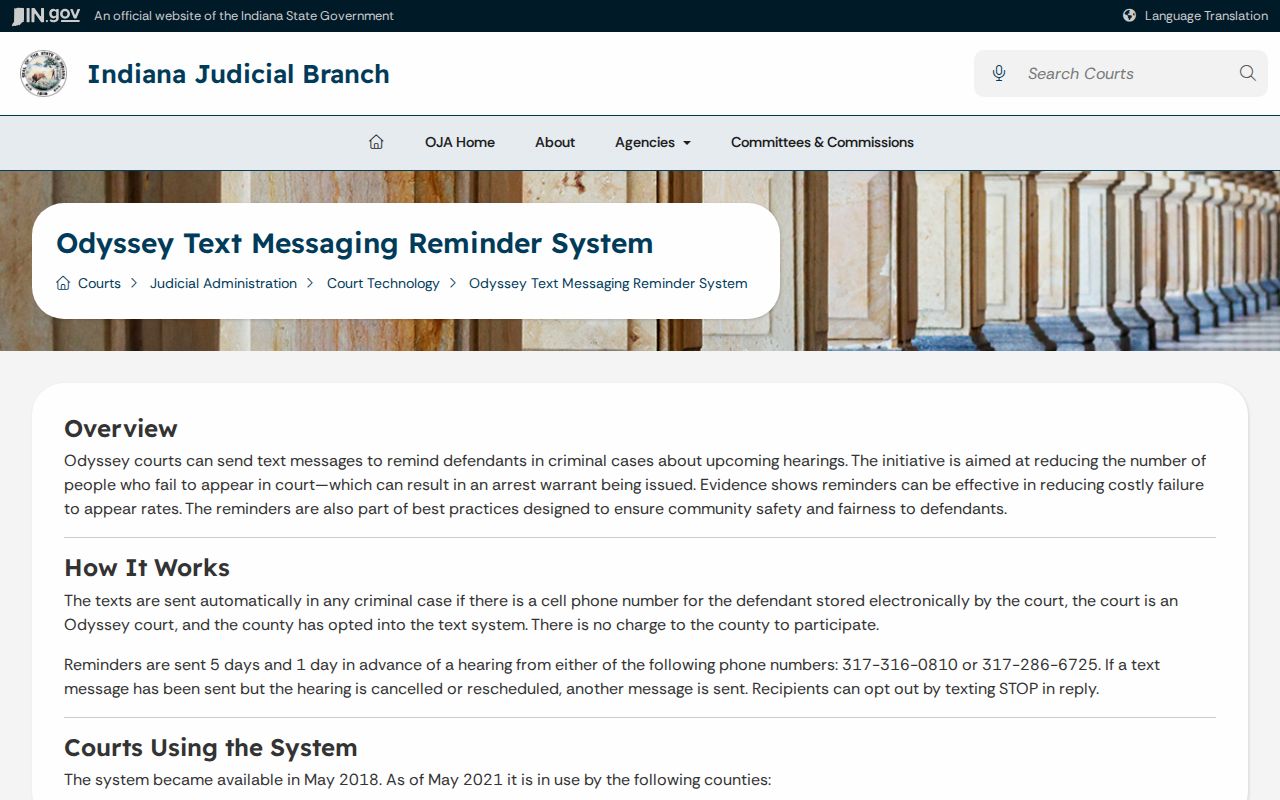
A text reminder is only a courtesy. In Rush County it does not replace a hearing notice or excuse an absence.
How Rush County Bench Warrants Are Issued
The Rush County judge assigned to a pending case sets appearance requirements. That judge also decides when bench process should follow. Either a criminal or civil case can produce it. Indiana law adds a wrinkle. In a misdemeanor begun by summons, a nonappearance without good cause can move the case toward an arrest warrant when the required charging and probable-cause conditions exist. Bench-warrant language also shows up after an indictment or information, before any arrest has been made. Labels mislead. Read the chronological docket and find the basis. Then ask the issuing Rush County court what the order requires, since juvenile, sealed, expunged, and other protected material may not be open online.
Rush Infractions Split by Month
Rush Local Rule LR70-AR 00-1 offers a clue for Rush County infractions. Infractions opened in odd-numbered months go to Superior Court. Even-numbered months go to Circuit Court. Other matters are generally assigned at random unless another local rule applies, so the month is a starting point rather than proof of venue.
| Filing clue | Likely court | Identifier |
|---|---|---|
| Odd-month infraction | Rush Superior Court | 70D01 |
| Even-month infraction | Rush Circuit Court | 70C01 |
| Other case | Read the docket | Use the cause number |
Search the citation or full cause number in MyCase, then verify it.
Rush Bench and Arrest Warrants Compared
Both kinds can lead to arrest in Rush County. The paths differ, though. An arrest warrant under Indiana Code 35-33-2 follows an indictment or a judge's probable-cause finding on an information. A bench or failure-to-appear warrant usually grows from an existing case, while a civil body attachment can compel appearance without a new criminal charge.
| Process | Typical basis | Control |
|---|---|---|
| Bench or FTA warrant | Missed hearing or condition | Judge in pending case |
| Arrest warrant | Indictment or probable cause | Issuing criminal court |
| Body attachment | Required civil appearance | Issuing civil court |
Both can hit the same person. The Rush County record shows the response each requires.
Rush Clerk Record Boundaries
The Rush County Clerk keeps the records for both Rush County courts at 101 East 2nd Street, Room 209. The public terminal and records room are open during normal hours. Staff do not run a broad criminal or civil case search. Call 765-932-2086 with a cause number, case name, document sought, and filing date. Copies cost $1 per page. Certification adds $3. Emailed copies carry no fee, though certified copies go out by mail or pickup. These are copy fees, not a warrant-search fee. Staff can read the docket and route a caller. They cannot find good cause, recall a warrant, or promise that payment clears it. Filing is separate from requesting a record. Rush County local rules let documents reach the courts in person, by U.S. mail, through e-filing, or by limited fax. A self-represented party may not file by email. The fax route caps at ten pages including the cover sheet and cannot be used when a fee is required. It must list the document title, case number, page count, sender identity, voice phone, and filing instructions. The original must follow as soon as practical. No motion-to-recall form exists here. Sending a document never means the judge granted it. Check the docket for the filed paper and any later signed order.
Family and child-support matters deserve the same care. The Rush County Prosecutor runs a Child Support Division, but the county publishes no child-support warrant list and no special recall form. A missed rule-to-show-cause hearing might bring contempt, an order to appear, or a civil body attachment. That is not a new criminal charge. Juvenile and family records can carry access limits. Ask the Clerk which public entry can be released. Then take the legal question to the judge's court, because the Prosecutor, the Clerk, and the Sheriff each hold a different role in Rush County. None can substitute its answer for the court's order.
Key point: Ask for a specific docket entry because the Clerk does not conduct an open-ended case search.
Finding the Court That Issued the Warrant
Start with the cause or citation number. MyCase takes both, plus cross-reference and party-name searches. When you can, apply the Rush County court filter, and match carefully: sounds-like name matching plus thin public identifiers makes similar names easy to confuse in a Rush County warrant lookup.
Rush Circuit Court
70C01
101 East 2nd Street, third floor
765-932-2078
Rush Superior Court
70D01
101 East 2nd Street, third floor
765-932-3520
Rush County Sheriff
131 East First Street
765-932-2931
Call the court for reset, recall, appearance, and bond directions. The Sheriff handles service, custody, and intake questions, though Rush County publishes no warrant division line and no online Sheriff roster.
Resolving a Rush County Bench Warrant
Confirm before anything else. Rush County posts no recall form, no standard bench-warrant bond, and no walk-in window, and paying money never guarantees a warrant comes back. The issuing judge picks the route that fits the case.
- Find the case and record the cause number, court, warrant event, next date, and bond entry.
- Ask the Clerk which court controls the order and which public document states its status.
- Call that court for recall, reset, appearance, filing, and bond instructions.
- Speak with counsel, then call the Sheriff before any surrender to check intake procedures.
- Obtain the recall, quash, served, or release entry and verify it with the court and Sheriff.
Warning: Never assume a payment, phone call, or online change recalled a warrant without an order from the issuing court.
The Rush County warrant records process page adds context on lawful surrender and bond planning.
Rush County Bench Warrant Record Fields
Read the warrant trail in the case docket, not a stand-alone Sheriff file. Rush County publishes no warrant-number prefix or status legend. Grab the cause number from the real case and follow events in date order.
| Cause number | Identifies county, court, case type, filing period, and sequence. |
|---|---|
| Scheduled event | Shows the appearance tied to the later order. |
| Process | May say bench warrant, FTA, body attachment, or another term. |
| Issuing court | Rush Circuit or Superior, which controls changes. |
| Bond | The amount and form, if entered. |
| Later event | May show served, recalled, quashed, or released. |
MyCase can carry errors or omissions in Rush County. Only the court file holds the official or certified entry.
Rush County Bench Bond Limits
Rush County publishes no uniform bench-bond schedule. Indiana law lets a judge order full cash, surety, an authorized ten-percent deposit, release without money bail, or a hold with other conditions. A figure you see online may be stale, so confirm the amount, the allowed form, and the payee before sending funds. State Clerk guidance sets a $5 fee on each full-bail deposit and allows a $5 administrative retention from an authorized ten-percent deposit. That guidance does not mean the ten-percent choice applies to your Rush County case. Bond covers custody only, as ordered. It does not dismiss the charge, excuse the missed date, or close the case. Ask the court whether surrender must happen before bond is posted, what identification is required, and where an approved payment is accepted. No Rush source says statewide ePay accepts a warrant bond. A third-party figure cannot replace a fresh answer from the court. Keep the receipt, note the next hearing date, and track every release condition. Then recheck the docket and ask the Clerk whether the expected entry has been filed. If the warrant status stays unclear, a lawyer can contact the Rush County court directly rather than guess at what an old online event still means. Note: Only the issuing Rush County court can give current case-specific bond terms.