
Checking for a Warrant in Rush County
The best public starting point is the Indiana MyCase portal. It pulls public case information from Rush Circuit Court and Rush Superior Court. Treat it as a first look. It is not a complete list of executable warrants. Search by cause number or citation number whenever you have one. A name search works when no number is known, though common names and spelling variants demand careful matching. Before calling anyone, gather the full legal name, date of birth, cause or citation number, and any hearing notice. Those details let the Rush County Clerk and court staff pull the correct public entry after the self-service search. Work it in that order.
- Search MyCase by cause number, citation number, or party name and limit the court to Rush Circuit or Rush Superior.
- Read the chronological case events for warrant, bench warrant, failure to appear, recall, quash, bond, or service entries.
- Call the Rush County Clerk with the specific case number and request the current public docket or named document.
- Ask the issuing court about status, recall, bond, or appearance instructions, then call the Sheriff about service or custody details.
- Seek legal advice before a planned surrender or filing, especially when the process is criminal, sealed, or marked as a hold.
Rush County has no separate municipal or justice-of-the-peace court to search. Indiana likewise posts no statewide criminal-warrant roster. A missed online result is never final proof, so confirm with the court.
Rush County Has No Warrant Roster
The Rush County Sheriff posts no searchable warrant list online. The Sheriff's official page gives an office address and main phone but no active-warrant form, roster, warrant-unit line, or most-wanted page. That gap changes the search method. It also means silence on the Sheriff page proves nothing. Skip unofficial lists and go to the court.
Quick answer: Use MyCase for public docket clues, then confirm the identified case with the Clerk, issuing court, and Sheriff.
Rush County Warrant Types
Indiana courts use several forms of process. The label matters. Trigger, public access, and next step can all differ by type. Rush County dockets do not use the Texas phrase "capias pro fine" for unpaid traffic matters. Read the court's own wording.
| Warrant Type | How It Arises | Who Issues It |
|---|---|---|
| Arrest warrant | An indictment is filed or a judge finds probable cause on a criminal information. | Rush Circuit or Superior Court |
| Bench or FTA warrant | A required hearing, summons response, release term, or court order is missed. | The judge handling the Rush case |
| Search warrant | Sworn facts establish probable cause to search for listed evidence or a person. | A court with lawful authority |
| Body attachment | A civil or family proceeding requires a person to be brought before the court. | The court handling that civil matter |
A tax warrant is a different animal. Indiana treats it as a tax collection and lien instrument, not an arrest warrant. Search-warrant affidavits and new criminal process may also stay sealed during an investigation.
Rush County MyCase Search Fields
The MyCase search interface splits case, name, and attorney searches. The strongest identifier is the number on a court notice or ticket. Name controls help when that number is missing. They can return unrelated cases.
| Field | Use | Rush County Tip |
|---|---|---|
| Case number | Direct cause-number search | Hyphens and leading zeros may be left out. |
| Citation number | Traffic or infraction lookup | Enter the exact stored value when possible. |
| Party name and DOB | Identity search | Add first, middle, and birth date to narrow the result. |
| Sounds-like | Alternate spelling search | Confirm every match against case details. |
| Court and status | Result filter | Use Rush Circuit 70C01 and Rush Superior 70D01; check open and closed cases as needed. |
The official Odyssey court list shows both Rush County courts in the system. Those Rush identifiers keep a search from drifting into another county.
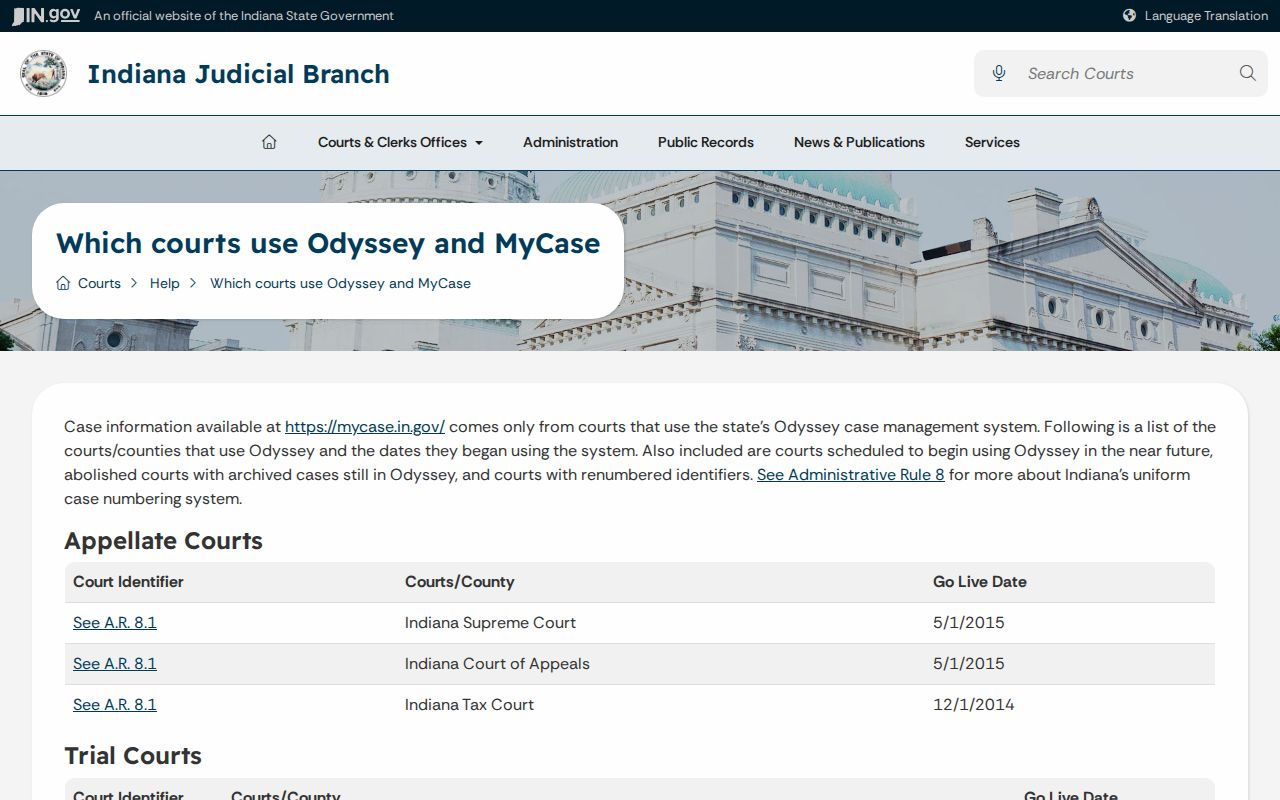
That court-system reference is official, but it says nothing about any private case. MyCase itself warns that its data may contain errors or omissions.
Inside a Rush County Warrant Record
A Rush County public case may show a warrant event, a linked public document, or later docket entries revealing service or recall. The county publishes no public warrant-number prefix. A cause number is the safer reference. Take it from the person's own record.
| Cause number | The Indiana court case identifier, such as the person's own 70C01 or 70D01 court record. |
|---|---|
| Process description | Arrest warrant, bench warrant, failure to appear, body attachment, or other docket language. |
| Person and charge | Name or lawful description plus the stated offense, classification, or court-order basis. |
| Issuing court | Rush Circuit or Rush Superior Court and the judge or order source. |
| Issue date and bail | When process issued and the court-set bail amount or type, if any. |
| Status events | Issued, served, recalled, quashed, returned, released, or other chronological entries. |
"Served" does not mean dismissed. Bond, release, recall, and final disposition are separate events, so ask the issuing court which one controls now in Rush County.
Rush County Clerk Search Limits
The Rush County Clerk page is blunt about limits. Staff do not perform undefined civil or criminal searches. The public terminal and records room are open during normal business hours, so search first and bring a cause number, case name, requested document, and filing date. Once the case is identified, the Clerk can provide a specified public record when access rules allow. Copy fees are modest but real. Hard copies cost $1 per page, and certification costs $3 for each certification. Emailed copies carry no copy fee, though certified copies are not emailed. A card may be used by phone for copy payment with a service charge. These are record-copy charges, not a fee to search for or clear a warrant. This is the terminal-and-records route behind Rush County warrant records.
That route works after you have identified the Rush County case. It does not turn Clerk staff into a name-search service.
Issuing and Serving Warrants in Rush County
Rush Circuit Court and Rush Superior Court issue criminal, bench, failure-to-appear, and related process in cases assigned to them. The shared Clerk keeps the docket and processes records under the court's direction. Indiana's arrest-warrant model directs written process to the county Sheriff. Rushville Police, Carthage Police, the Glenwood Marshal, Indiana State Police, or another authorized agency may also encounter or serve lawful process in Rush County.
Warrant flow: charging or missed obligation › judicial order › Clerk docket › Sheriff or police service › hearing, bond, recall, or return entry.
Rush County Clerk
101 East 2nd Street, Room 209
Rushville, IN 46173
765-932-2086
Only the issuing court can recall or quash its order. The Rush County Sheriff can answer service and custody questions but cannot replace the judge.
Rush County Court Assignment Clues
Rush County runs both of its trial courts under one roof, but the dockets stay separate. Under the local rules, infractions filed in odd-numbered months belong to Superior Court. Even-numbered months go to Circuit Court. Other matters are assigned at random unless a different local rule applies. The filing month is a clue. It cannot tell you where a Rush County warrant is held today. A transfer or a later order can change the route. Trust the court named in MyCase. Do not hunt for a Rushville city court, because no separate city court appears in the official directory. The Rush Circuit Court and Rush Superior Court each publish their own contact page. The Circuit Court page lists the court's contact details and courthouse location. When you call, quote the full cause number. Circuit uses 70C01 in Odyssey and Superior uses 70D01. The Rush County Clerk can identify the public docket, while court staff can explain scheduling and the judge's current order within the limits of what staff may provide. Neither court page promises a warrant counter or instant recall service.
The court image helps distinguish the issuing-court channel from the Sheriff's service role.
If You Have a Warrant in Rush County
Start by writing down the cause number, the court, any warrant or FTA event, the next hearing, and any visible bond entry. Call the Clerk with that number. Then ask that court what its order requires. The answer might be an appearance, a reset, a recall request, a surrender, a bond, or another case-specific remedy. Rush County publishes no recall form. It has no standard bond schedule either. No office in Rush County offers a guaranteed safe walk-in window for a warrant. Before you appear anywhere, call the Sheriff. Ask where intake happens, whether walk-ins are accepted, what identification to bring, and how a court-approved bond is handled. Counsel may arrange a lawful appearance or file a motion for you. The Rush County Public Defender is an appointment office. Do not assume representation before a court appoints counsel. Rush County local rules also shape filing. A self-represented person may file in person, by mail, through an approved e-filing path, or by limited fax when the rules permit. Email is not an option for pro se filings. A fax must carry its title, cause number, page count, sender identity, voice phone, and a cover sheet; it cannot run past ten pages or require a fee, and the original must follow. Those controls still do not create a standard recall form, so ask the Clerk or counsel which document the judge wants before you send anything.
Important: Obtain current instructions before surrender or payment; a web result cannot promise recall, release, or a no-arrest visit.
Once you act, get the order or docket entry. Then ask the Clerk when MyCase will show the change, because payment or bond does not dismiss the underlying Rush County case.
Rush County Warrant Status Terms
Short docket labels can hide very different stages in Rush County. No public legend covers every local status code, so treat these terms as a reason to call rather than a guess.
- Active or outstanding
- Process appears unresolved or executable, subject to direct confirmation.
- Served
- The process was executed or returned as shown; the main case may continue.
- Recalled
- The issuing court withdrew the warrant. Obtain the actual order or docket entry.
- Quashed
- The court set process aside, though another hearing or order may remain.
- Failure to appear
- A required court date was missed and may have led to a warrant event.
A closed case can still hold historical warrant events. An open one does not prove an active Rush County warrant exists, so read the event dates and verify the newest order.
Rush County Warrant Records and Public Access
The Indiana Access to Public Records Act covers Rush County government records. Exclusions still apply. Court records also follow the Indiana Rules on Access to Court Records. You may request an identified public record, but no office has to create a new countywide warrant list or hand over sealed and protected material.
Key rules:
Indiana Code 5-14-3 permits requests for existing public records and allows lawful exemptions.
Court Access Rule 5 protects authorized pre-arrest, sealed, juvenile, and other confidential material.
Indiana Code 35-33-2 states the grounds and required contents for a written arrest warrant.
Investigatory records may be withheld under APRA. A Rush County denial should still release any non-exempt part and state the legal basis in writing.
Rush County Sealed Record Gaps
A new Rush County warrant may simply not be online yet. Pre-arrest charging or probable-cause material may be withheld. Indiana access rules allow that when release could raise flight risk, threaten safety, or harm an active investigation. Juvenile, expunged, protection-order, pretrial, and probation records may be restricted in Rush County too. MyCase hides some documents even in a public case. The limit cuts both ways. A blank result does not end the question. An old one does not prove process is active. Use a specific cause or citation number when you ask for confirmation. If the matter may be sealed, let counsel contact the proper court without relying on a public web result. An APRA request must name an existing record. It cannot force an all-active-warrants report from the Sheriff. Nor can it certify that no warrant exists. Describe the incident or process as narrowly as possible. For a court document, give the Clerk the cause number, case name, document title, and filing date. If part of a record is exempt, ask whether a non-exempt portion can be released. Also request the legal basis in writing for any denial. Note: Rush County warrant records must be confirmed with the originating court or Sheriff when the public view is incomplete.
Rush County Hearing Reminder Program
Rush County takes part in Indiana's Odyssey hearing-reminder program. It is a simple idea. When a court joins in and a cellphone number is on file, the state sends an automated text about an upcoming criminal hearing. That nudge matters here, because a missed date is the fastest route to a bench warrant in Rush County. Treat the text as a safety net, though. It is not formal notice, and it cannot change a judge's order. If no text arrives, that proves nothing either way. Check MyCase, read the official notice, and call the court when a date is unclear; the program prevents failures to appear but clears no warrants and grants no amnesty.
Rush County Traffic Deferral Limits
The link above aside, ticket relief runs through the Rush County Prosecutor, who posts an infraction deferral for eligible tickets. The total runs $192.50. The program lasts twelve months, carries listed offense rules, and expects a response within 72 hours. One warning stands out: do not pay the ticket through court first, since that payment may go straight to the BMV. Ask about deferral before you send money anywhere. And know what deferral is not. It is not warrant amnesty, and it promises nothing about recalling an existing failure to appear. If MyCase already shows enforcement in motion, call the issuing Rush County court for direct instructions before paying any portal or program fee.
Rush County Warrants by City
Rush County lists three incorporated places in the official state tally. None of them runs its own municipal court. For local citation-routing questions, city police or a town marshal can point the way, but a warrant filed in Rush County belongs to Rush Circuit or Superior Court, and the County Sheriff handles service and custody questions.
Rushville Warrant Search
Population 6,208 · City police serve the county seat; no separate city court or warrant portal was located.
Carthage Warrant Search
Population 918 · Town Hall houses local police, while the Sheriff also serves the town.
Glenwood Warrant Search
Population 245 · The Town Marshal uses a public email, and the county line must be checked first.